Tuesday, June 18, 2013

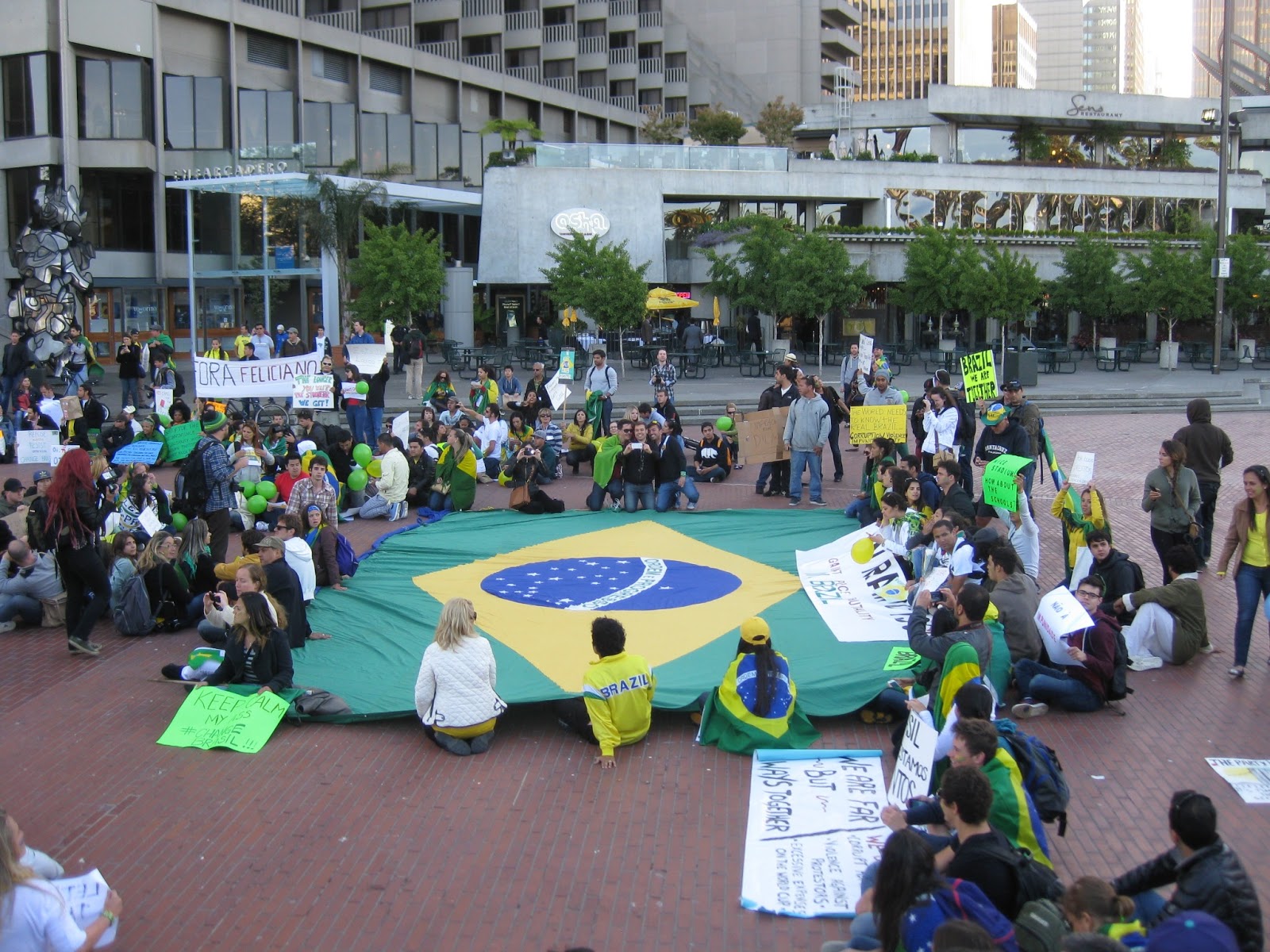
San Francisco Brazilian Protests Solidarity Rally

Protesters wearing Brazilian flags
Another popular uprising, another San Francisco solidarity rally.  


Similar to the large-scale protests in Turkey prompting a San Francisco solidarity rally a few weeks ago, the recent multi-city Brazilian protests motivated some to organize a San Francisco solidarity rally with the Brazilian protests today.
Protesters unfurled a large Brazilian flag
The rally started at 6pm at Justin Herman / Bradley Manning plaza.  Protesters held up signs, took photos of each other, chanted and sung songs.  Most of the event seemed to be conducted in Portuguese. There was at least one brief speech, but the PA system didn't carry the sound too far.

Protesters holding a sign listing the grievances of the Brazilian protest movement
There didn’t seem to be any single Twitter hashtag for the San Francisco event, but tags for the Brazilian protests in general are: #OGiganteAcordou #CHANGEBRAZIL #ProtestaBrasil #OBRASILACORDOU

A San Francisco sign draped over the large Brazilian flag
The call for the protest follows:


Brazil is currently experiencing a widespread collapse of its infrastructure. There are problems with ports, airports, public transport, health and education. Brazil is not a poor country and the tax rates are extremely high. Brazilians see no reason to have such bad infrastructure when there is so much wealth that is so highly taxed. In the state capitals people spend up to four hours per day in traffic, either in their cars or on crowded public transport which is of very poor quality.

One gripe of the protesters is Brazilian government spending
on the World Cup in lieu of other social needs
The protests are not mere isolated, unionized movements or extreme left riots, as some of the Brazilian press says. It is not a teenage rebellion. It is the uprising of the most intellectualized portion of society who wants to put a stop to these Brazilian issues. The young national mid-class, which has always been unsatisfied with the political oblivion, has now "awaken" - in the words of the protesters." (please read the full article here:http://ireport.cnn.com/docs/DOC-988431)

The protests in Brazil were catalyzed by a 20 cent public transportation fare hike
So we, the brazilians who live outside of Brazil would like to invite everyone (brazilians, americans, etc!) to this protest in order to support our friends who have been unfairly arrested, who haven't had their basic rights to protest against a corrupted government. And on top of that we also would like to show the world the problems that our country is facing.

Balloons were plentiful at the rally
Please invite your friends, spread the word and join us in solidarity to the oppression that has been going on in Brazil!
Univision was on the scene


Sunday, June 9, 2013

Billboard Defacement / Improvement on Cesar Chavez and Mission

The very visible billboard on the corner of Mission and Cesar Chavez streets is wonderful because it invariably gets graffiti sprayed all over it mocking the ridiculousness and offensiveness of the advertisement. 

The beer ad says (in Spanish): "It is easy to be a man with character."

The graffiti says (in Spanish): "The people do not believe in this."

The people speak!

Mark Zuckerberg, Larry Page, and other PRISM-Denying Liars of Silicon Valley

The First Watergate Law of American Politics states: "No matter how paranoid or conspiracy-minded you are, what the government is actually doing is worse than you imagine."


The Second Watergate Law of American Politics states: "Don't believe anything until it's been officially denied."


Both laws are still on the books.


-- William Blum, Rogue State


Blum’s dictums are as accurate and necessary for understanding corporate power as they are political power.  With that in mind, dear reader, let us proceed to consider the likelihood of various Silicon Valley corporations’ denials that they are involved in the mysterious National Security Agency PRISM program.


First, some brief background.  Journalist (or, according to the New York Times, “blogger”) Glenn Greenwald has been breaking a series of exclusive stories about the nature of the NSA’s top secret programs in the past week.  First, he broke the news that a Verizon, at the behest of the Obama administration via a secret Foreign Intelligence Surveillance Court order, had been forking over the metadata of millions of subscribers’ phone calls to the NSA.  Next, he disclosed the existence of the PRISM project, a secret collaboration between various Silicon Valley corporations and the NSA to analyze user data stored on the companies’ systems.  After that, he published about Obama’s order to draw up a list of foreign targets for cyber attack and about another NSA tracking program, Boundless Informant.


Here I want to focus on the PRISM revelation only.  The reaction of the leaders of the corporations with whom the NSA had been allegedly collaborating was shock, outrage and denial.  Google CEO Larry Page co-authored a blog post with Google’s top lawyer entitled “What the...?” in which the authors claimed that “Any suggestion that Google is disclosing information about our users’ Internet activity on such a scale is completely false.”  Facebook CEO Mark Zuckerberg followed suit with a response to what he called the “outrageous press reports” that read very similarly to Page’s.  Indeed, according to the Guardian, the newspaper which Greenwald writes for, “All the companies involved have now denied knowledge of [PRISM].


Naturally, these carefully-written denials don’t directly address all the alleged issues and are open to wide interpretation.  Most notably, the companies deny the NSA having “direct access” to their servers, which begs the question of what “direct access” is, exactly, and doesn’t preclude the possibility of indirect access.


So the NSA can’t both be collaborating and not collaborating with the companies.  Someone is in the wrong, either Glenn Greenwald or the Silicon Valley corporations.


Unfortunately for Facebook and Google, et al, evidence seems to be mounting on the side of their collaboration with the NSA.  According to the Washington Post, “Executives at some of the participating companies, who spoke on the condition of anonymity, acknowledged [PRISM]’s existence and said it was used to share information about foreign customers with the NSA and other parts of the nation’s intelligence community.”  Furthermore, the Guardian has published additional evidence about PRISM and several other news sources corroborate Greenwald’s original accusations.  Greenwald doesn’t appear to be finished, either, hinting that more incriminating stories are yet to be published.


It seems pretty clear, and I believe the evidence will bear this out as time goes on, that Mark Zuckerberg, Larry Page and the rest of the Silicon Valley titans are lying.  There are, of course, less likely alternate possibilities: that the executives are so misinformed that they don’t know what is going on at their own companies, for instance.  But I agree with security expert Bruce Schneier when he says: "I was assuming that these tech companies were just lying... That's the most obvious explanation."

George Packer recently wrote a piece -- “Change the World” -- in the New Yorker about Silicon Valley, partially addressing its corporations’ increasing involvement in politics.  Towards the end, he observes, “If Silicon Valley’s idea of itself as a force for irresistible progress is running up against the unlovely reality of current American politics, that isn’t necessarily a bad thing.”  In the context of industry collaboration with secretive government surveillance programs, one might add, “And long overdue.”  Although Packer clearly didn’t have the presently breaking scandals in mind, it’s clear that the power of these companies to engage in such nefarious and possibly illegal activity should be reined in, as quickly and as strongly as possible.

Saturday, June 1, 2013

San Francisco Taksim Gezi Park Protests Solidarity Rally

The Turkish flag flying
Supporters of the ongoing protests regarding the planned destruction of Taksim Gezi Park in Turkey staged a rally in San Francisco today.  The event in front of City Hall was well attended (several hundred people), well organized and the attendees displayed great enthusiasm for their cause.  This protest had perhaps the greatest sign density of any protest I’ve ever seen.

Protesters posing with signs for photographers
Signs varied greatly in content from “Enough with Erdogan’s Advanced Fascism” to Turkish flags and pictures of Mustafa Kemal Atatürk (Turkey’s first president and a symbol of secular, modern Turkey).
A couple with a picture of Ataturk
The rally, in both signs and speeches, was conducted mostly in Turkish.  There were some English signs and speeches.  The speakers denounced the brutality of the police and praised the Turks defending the park.  One fiery speaker insisted that Turkey never had a democracy, since Turkey has always been under the thumb of America and NATO. Another speaker encouraged attendees to educate the crowd's non-Turkish friends about the issues at hand.
A moment of silence, as the speaker holds up a peace sign
Attendees were mostly Turkish, unsurprisingly. All ages were present, from the elderly to moms with baby strollers.

The call for the rally follows:


"To All Democracy and Free Speech Supporters in the World,


There is an ongoing public uprising in Turkey which one might call as the Turkish Spring against the anti-democratic regulations of the current government. The uprising was sparked by a police attack against peaceful protestors in Taksim, Istanbul who were gathered in a public park (Gezi Park) to protest the planned shopping mall construction by removal of the park, one of the few remaining green areas in downtown Istanbul. The peaceful sit-in protestors who were in the area since beginning of the week were attacked by the police forces on Friday May 31, 2013 around 5 am by tear gas and water cannons without any warning. These protestors were just ordinary people who were there to save trees from being toppled down by bulldozers, to voice their opinions about the fate of their city by exercising their constitutional right to a peaceful demonstration. The unnecessary and excessive use of police force against demonstrators and non-demonstrators alike in the area have caused an outrage among the public drawing more crowds to Taksim area.


Ongoing police brutality and reports of injuries sparked even more protests all over Istanbul and spread to other cities turning into country wide demonstrations against Prime Minister Tayyip Erdogan and his "increasingly authoritarian and uncompromising tendencies" as Associated Press has called it. In many cities, people from all parts of the society, believers, non-believers, different ethnic backgrounds, different party voters have gathered on the streets demanding the police violence against public to come to an end and chanting for Mr. Erdogan's resignation.


The major media either supporter of the government or oppressed by the government is turning a blind eye on the developments. The main source of communication is basically the social media such as facebook, twitter and civil people broadcasting from the streets to various sites using their cell phones. People of Turkey is reading reports or watching videos about what is going on in their country from international press coverage due to lack of local media reports. There is also growing concern among the public that internet access will be banned by the government.


Please us help to spread the outcry of public in Turkey to stop the police violence against public and anti-democratic regulations.


So far, 51 people are arrested, there are many injured protesters in hospital, one being in a coma.


We, the Turkish Americans living in the Bay Area, are gathered to show our support to the protesters in Istanbul, and let them know that they are not alone. Their efforts are noble and even though we can't physically be there, our hearts and minds are with them.


We hope that those in power would yield to public demand and would leave the trees of Gezi Parki alone, so the city residents can continue to enjoy the park.

SF Bay Area Turkish Americans"


Hashtag for the event: 

Friday, May 17, 2013

Reflections on a Journey to Cuba

Sunrise in Havana as seen from the roof of the Hotel Parque Central

“Wait, you can go to Cuba?”


That seems to be the reaction of most Americans I talk to when I reveal that I have returned from a recent trip to Cuba.  Indeed, Cuba is a bit of a diplomatic special case since the US does technically restrict the travel of its citizens to the island.  Unless one is on a diplomatic mission or some other such extenuating circumstance, one would have to travel to Cuba out of the sight of US authorities -- via Canada or some such.


Sunset in Cienfuegos
That is, until recently.  Thanks to President Obama (one of the few times I will type these words non-ironically), there are a number of exemptions that ordinary Americans can obtain to travel to Cuba.  These include people-to-people cultural exchange programs, such as the one that I participated in through Stanford University.  

Other exemptions can be for religious organizations doing cultural exchange.  By coincidence, I met an American (who happened to live a couple blocks away from me in San Francisco) at the Havana airport travelling with his church group.  There was also a minor stir caused by Beyonce and Jay-Z who happened to be in Havana at the same time that our group was.  It turned out that they, too, had an exemption from the Treasury Department (yes, the Treasury Department issues these) -- an educational one, mind you.

Jay-Z and Beyoncé on a Havana balcony (photo credit: Greg Surrurier)
Contrary to popular belief, there is much interaction between the United States and Cuba, albeit less than that of countries with normalized diplomatic relations.  There is a US diplomatic presence in Cuba (called the US Special Interests Section) and vice versa.  Flights travel between Cuba and the US every day carrying both Cubans and Americans.  In the Miami airport, for instance, there are several ticketing booths run by ABC Charters, the airline my trip used.  Cuba is a recipient of food and other aid from the US, so much so that in 2012 Cuba imported more agricultural products from the US than from any other country.

My desire to visit Cuba was driven partially by a naive belief that there might be some kind of cataclysmic reconfiguration of the island after the inevitable end of the Castro regime, and an urge to see the island as it was before the all the McDonald’s sprang up.  I learned, however, that some gradual change has already taken place on both sides of the Straits of Florida which has recently reconfigured the face of Cuba.
Visage of Ernesto "Che" Guevara in Havana's Plaza de la Revolución
On the Cuban side, the government has implemented a variety of notable reforms in the past few years.  First of all, Cuban citizens no longer need the permission of the government to travel abroad.  Second, buying and selling real estate is now allowed by the government.  Are these changes as drastic for Communist Cuba as they appear on face value?  Kind of, sort of, maybe.  Government policy in Cuba is unpredictable and fickle, the infrastructure for a policy usually comes after it has been announced, and many other rules, regulations and provisions -- explicit and implicit -- prevent these policies from being implemented to their logical conclusion.

On the US side, Obama also lifted travel restrictions on Cuban citizens and removed restrictions on remittances to family members in Cuba, among other changes.  The sense among Cubans that I talked to was that the combination of remittances and liberalized real estate laws were allowing Florida-based Cuban-Americans to acquire property on the island.  But again, there are a multitude of official policies that limit the extent to which this can happen (only certain familial relations can transfer land to others under certain conditions at certain points of time etc. etc. etc.).  I can’t claim to understand all of them, partially because there seemed to be so many.
A donkey in Trinidad
The experiments with privatization by the Cuban government aren’t totally unprecedented.  As I learned throughout my travels, there already exist enclaves of private ownership in the sea of public ownership.  Paladars, or privately owned restaurants, have existed since the government was forced to experiment during the economic catastrophe known as the “special period” when the USSR -- Cuba’s main trading partner -- disappeared from the face of the earth.  (GDP in Cuba dropped by around thirty percent over the next several years.  To compare the severity of this crisis, consider that the dismal economic situation in America is caused by GDP that is actually growing, just not fast enough for some people’s taste!)  Much of the privately-owned sector seems to be in tourism: hotels, taxis, restaurants, etc.  In that sense there is somewhat of a two-tier economy in Cuba.

As a Western tourist, you would have to be blind not to notice that you exist in the higher economic tier, compared to the average Cuban.  Eating meat and fish at the paladars is different from rice and beans purchased from one of the often-empty stores selling subsidized staples.  Staying in a nice hotel is a far cry from living in a crowded, crumbling building.  Touring the countryside in an air-conditioned bus sure beats plodding around in a barely-functional 50’s automobile.  There is even a separate currency, the CUC, which is used by tourists and other privileged members of Cuban society (government, military, business people) to buy items that are out of the reach of most Cubans, who deal in regular pesos.

Lineup of antique American cars in Havana
Oh yes, did I mention the crumbling buildings?  The signs of decay are everywhere in Cuba’s architecture.  Even on the main tourist strips and inside the landmark museums, peeling paint, collapsed outcroppings and cracked facades are a constant sight.  It is not uncommon for entire buildings to outright collapse in Havana.

The life of the ordinary Cuban is difficult.  Whenever one would quote us his or her salary, we in the tour group would marvel at how he or she was still alive.  It seems like everyone is forced, one way or another, to survive on some combination of their salary, subsidies and the black market -- the black market being the most lucrative.  One apropos experience that stands out in my mind is a visit I took to a Cuban cigar factory.  The factory workers were quite openly offering to sell us cigars as we walked the floors, which of course is expressly illegal.  We did some math and determined that only one sale to a tourist would double a worker’s daily salary.  
Plowing fields, old school, in Havana
Opinions of Cubans are mixed with regards to the current state of affairs, the Revolution and the future.  It seems that Cubans respect the Revolution and the positive aspects that it has brought to the people against great international adversity, but they would also be welcome to economic improvements in their life that the Revolution cannot offer.  Some think that younger Cubans have less interest and investment in the Revolutionary ideals.  One speculated that half of the population would leave the island for the US if given the chance.  But it seems that most would be against a complete capitalist takeover of the island, dismantling the community and culture that Cubans treasure.
Man in Havana selling state newspapers
Regardless of perspective, it appeared that every Cuban I talked to was pretty frank with his or her opinions.  All seemed to agree that the political repression had significantly slackened in the past several years to the point where one effectively ignored it in his or her day to day routine.  There are exceptions, however, and people seemed to believe that any significant agitation against the government was still taboo.
Driving down Havana's Malecón in a 50's Chevrolet
My communication with Cubans was easy in part because so many of the people I interacted with spoke English (my Spanish could be generously described as rusty).  English displaced Russian as the mandatory foreign language in schools after the collapse of the USSR.    Also, most of the tourist industry workers tend to be highly educated professionals.  This dynamic is the sad and predictable consequence of a poor country that doesn’t offer its professionals sufficient career opportunities to prevent them from taking a job in the virtually lone sector in which it is possible to earn a decent income.  Naturally, my opinion of Cuban life is disproportionately influenced by interactions with this professional class which accounted for most of my candid conversation with Cubans.
This Havana kid thought that the rip in my shirt was hilarious.
What is the solution to Cuba’s economic problems?  One thing is for sure: unleashing unbridled capitalism upon the island, the thought of which many American policymakers salivate over, is not it.  One need only to look to Cuba’s nearest neighbor, Haiti, to see what might lie in store for Cuba if that scenario were to play out.  In fact, Communist Cuba is doing quite well economically in comparison to its Greater Antilles neighbors.  According to the CIA World Factbook, GDP per capita in Cuba is 91st in the world, and countries with similar histories, locations and climates rank below it.  The reality is that Cuba is a relatively poor, undeveloped country and will remain that way for the foreseeable future.  If the reader is hoping for some positive policy prescriptions, unfortunately I feel that I do not have nearly the knowledge of Cuba’s situation required to make any informed ones of much use.

Whatever developmental course Cuba chooses to pursue, the US could help out by getting out of the way.  America has a very long history of terrorism, invasion, proxy dictatorship and general nastiness with respect to Cuba that I won’t go into fully here.  Suffice it to say that American designs on Cuba go back to hundreds of years, really got going with the Spanish-American War, and continue to the present.  Currently the US maintains its economic embargo on Cuba which every year is condemned by the United Nations General Assembly (the US, Israel and Palau were the only dissenting votes in 2012).  America also lists Cuba as a state sponsor of terror (along with Iran, Sudan and Syria).  An obvious first step, if the US wanted to stop antagonizing Cuba, would be to drop these two policies.
Missiles that were (not) used in the Cuban Missile Crisis outside Cienfuegos
Beyond that, the US could go from being a neutral country viz. Cuba to a friendly one.  There are plenty of reasons why this would be a natural arrangement.  The close proximity, the large Cuban-American population (over one million strong in the US) and the shared history and culture.  Everywhere we went in Cuba, for instance, there were statues and busts of Abraham Lincoln, considered a hero for the same reasons that many Americans hold him in high regard.  His philosophy was influential on José Martí, the most important figure in the Cuban independence struggle.
The Cuban flag flying near the tomb of José Martí in Santiago, Cuba

But as it stands, Cuban-American diplomatic relations are typically strained.  Throw in Guantánamo Bay (a controversial American military base on Cuban soil), the cast of alleged terrorists, spies and political prisoners that each side accuses the other of mishandling (Alan Gross, Assata Shakur, The Cuban Five, Luis Posada Carriles, etc.) in addition to the shenanigans already mentioned, and one has a recipe for an icy relationship that shows no signs of thawing.
Propaganda poster in Guantánamo province
But who knows?  If Cuba’s current president, Raúl Castro, is true to his word, the Castro regime will end in 2018.  Perhaps that will be the start of a diplomatic rapprochement.  Or maybe one will start before then.  Or maybe things will continue on as they are now.  Really, what the future holds for Cuba is anyone’s guess.

In sum, these are just some rambling thoughts on the contemporary Cuban political economic situation informed by my recent visit to Cuba.  I don’t really have any point to push here, but rather have attempted to give a brief glimpse into what Cuba is actually like today.

Yours truly reflecting on the day in Baracoa


Further reading


Update

Some have commented that I have not given enough space to the positive accomplishments of the Cuban government.  These include: