Friday, April 18, 2014

Book Review: Multitude by Michael Hardt and Antonio Negri


Reading Multitude: War and Democracy in the Age of Empire, Michael Hardt and Antonio Negri's 2004 follow up to Empire is a maddening exercise.  Wrapped in layers of superfluous pedantry and literary digressions, the book's core argument is not terribly complicated.  The idea of the multitude is, however, a novel revolutionary construction, albeit without a clear politics to make any practical use of it.

For Hardt and Negri (HN), the "multitude" is a not a unit with a unified identity, unlike the "workers" of Marxist yore.  Rather, it is a "multiplicity of... singular differences," (xiv) a group that brings about the possibility of "democracy on a global scale." (xi)  This multitude "must discover the common that allows them to communicate and act together" (xv) to resist the Empire, a "new form of sovereignty" (xii) that includes states, corporations, supranational institutions, etc.

The book is divided into three parts, War, Multitude and Democracy.  In War, HN lay out our contemporary landscape: we are living in a world of constant, interminable, global civil war, where war is the "primary organizing principle of society." (12)  The state of exception that traditionally signified war "has become permanent and general" (7) and this war is "indistinguishable from police activity." (14)  However, one should note that the "dominant military power often finds itself at a disadvantage in asymmetrical conflicts," (51) facing a "network enemy," (55) which prompts it to formulate new tactics and strategies in response.  So far, HN seem to be describing approximately the George W. Bush "war on terror."  But HN go a step further in claiming that the multitude's resistance is creating the conditions for its own political ascendance: "The distributed network structure provides the model for an absolutely democratic organization that corresponds to the dominant forms of economic and social production and is also the most powerful weapon against the ruling power structure." (88)

HN open the Multitude section declaring "Political action aimed at transformation and liberation today can only be conducted on the basis of the multitude." (99)  In the multitude, HN state, there is "no political priority among the forms of labor" (106).  "Immaterial labor" (a term with a very expansive and ambiguous definition) is becoming the hegemonic form of production in post-Fordist society (108) -- labor that is also unusually flexible, mobile and precarious (112).  This multitude includes the so-called lumpenproletariat because they too are "included in social production," (129) a type of production that happens "equally inside and outside the factory walls... [and] inside and outside the wage relationship." (135)  (HN helpfully distill the differences between their method and Marx's in Excursus 1 (140-153).)  Signs of the multitude were glimpsed, HN claim, during the Seattle WTO protests, Zapatista movement, global Iraq War protests and 2001 Argentine actions. (215-7) (Excursus 2 (219-227) addresses critiques of HN's philosophy, sometimes unconvincingly.)

In the Democracy section, HN observe that democracy is "confronted today by a leap of scale." (236)  They see contemporary forms of democracy as inadequate for the multitude, quipping "The political lexicon of modern liberalism is a cold, bloodless cadaver." (273)  They conclude by arguing "What is necessary is an audacious act of political imagination to break with the past, like the one accomplished in the eighteenth century." (308)

It is clear that HN had recent anti-globalization and anti-war protests on their mind when they wrote this book, but conceiving those actions as the basis of a new democracy / resistance / movement that obviates all previous ways of thinking about politics seems misguided, especially since the Iraq War protests would seem to have been the high point of this network.  It seems that in the absence of a powerful Left HN have used a "weakness is strength"-type argument to position society on the precipice of a new global democracy.  In the end, HN's classless "us" vs their undifferentiated "them" fails to convince.

Also see this review of Empire in NLR.

Thanks to Aaron Benanav for conversations regarding this book.


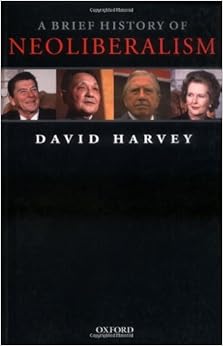
Book Review: A Brief History of Neoliberalism by David Harvey


Many often throw around the term "neoliberalism," to refer to recent political, economic and historical events, but what is it, exactly?  David Harvey attempts to answer this question in 2005's A Brief History of Neoliberalism.

Harvey opens the book with the definition: "Neoliberalism is in the first instance a theory of political economic practices that proposes that human well-being can best be advanced by liberating individual entrepreneurial freedoms and skills within an institutional framework characterized by strong private property rights, free markets and free trade." (2)  This goes hand in hand with the neoliberal state, which Harvey says is "a state apparatus whose fundamental mission [is] to facilitate the conditions for profitable capital accumulation on the part of both domestic and foreign capital." (7)  Harvey writes that neoliberalism has become "hegemonic as a mode of discourse." (3)

Harvey identifies some notable events in the advent of neoliberalism as:
  • The 1971 Lewis Powell Memo (43)
  • The 1971 dismantling of the Bretton Woods system (12) 
  • Policy changes in Chile after the 1973 Pinochet coup ("The first experiment with neoliberal state formation" (7))
  • The 1970s New York City fiscal crisis ("a coup by the financial institutions against... New York City" (45))
  • The 1979 Volker shock ("a necessary but not sufficient condition for neoliberalization" (24)) when the Carter-appointed chairman of the Fed hiked interest rates dramatically, curtailing inflation without regard to employment
  • The foundation of think tanks / takeover of economics departments to promote neoliberal ideology (54-7)
  • The union-busting, etc. policies of Thatcher and Reagan 
  • "Structural adjustment" policies of the IMF (29)
  • Deng Xiaoping's 1978 announcement of Chinese economic reforms (120)
To address the question of why neoliberalism has dawned upon the world, Harvey traces the beginning back to when "embedded liberalism" proved "inconsistent with the requirements of capital accumulation." (13)  Since the bourgeoisie saw its economic and political power disintegrating, Harvey argues, "The upper classes had to move decisively if they were to protect themselves from political and economic annihilation." (15)  He states the evidence suggests that neoliberalism is a political project to restore class power, even though neoliberalism's ideologues proclaim it as a promoter of economic growth and freedom -- goals on which neoliberalism has continuously failed to deliver. (19)

Even the neoliberal theory, as embodied in such documents as the missives of the Mont Pelerin Society, has its contradictions: its distrust of state power vs its advocacy of a strong and coercive state; its scientific rigor vs its political commitments to freedom and defining corporations as individuals in legal terms (21).  In practice, neoliberalism provides further contradictions with the theory: squeamishness over democracy, monopoly power, collective action and market failure (66-8); favoritism of a "good investment climate" and preferring financial stability to population welfare; forcing international state borrowers to pay back bad loans (70-74); its tendency towards authoritarianism and financial moral hazard (79-81); etc.

Such contradictions prompt Harvey to declare the neoliberal state "either a transitional or unstable political form." (79)  He sees the increasing neoliberalization of authoritarian states (China) and increasing authoritarianism of neoliberal states (US, UK) as converging to the same type of regime, a neoconservative one that provides "order as an answer to the chaos of individual interests" and "overweening morality as the necessary social glue to keep the body politic secure in the face of external and internal dangers." (82)  But Harvey warns against this development, advising, "To avoid catastrophic outcomes therefore requires rejection of the neoconservative solution to the contradictions of neoliberalism." (86)

The neoliberal state has a paradoxical relationship with nationalism.  On the one hand, "the umbilical cord that tied together state and nation under embedded liberalism had to be cut if neoliberalism was to flourish." (84)  On the other hand, the state needs to mobilize nationalism to promote itself in a competitive global marketplace.  But cultivating this nationalism can also pose a danger to neoliberal interests at times, either in the form of anti-immigrant movements or national movements against neoliberal leaders. (85)

Chapter four details case studies of various countries' experience with neoliberalism -- Harvey highlights Mexico, Argentina, South Korea and Sweden.  Chapter five deals with the case of China.

Evaluating the success of neoliberalism according to its stated aims, Harvey finds "its actual record turns out to be nothing short of dismal." (154)  However, policy has not changed because neoliberalism "has been a huge success from the standpoint of the upper classes." (156)  That is because "The main substantive achievement of neoliberalism... has been to redistribute, rather than to generate, wealth and income." (159)  Harvey believes the "accumulation by dispossession" regime that neoliberalism has brought about utilizes techniques of privatization and commodification, financialization, the management and manipulation of crises and state redistribution to achieve its ends. (160-5)

In the final chapter Harvey ponders the end of neoliberalism, warning that "regimes of accumulation rarely if ever dissolve peacefully." (189)  "The consolidation of neoconservative authoritarianism," Harvey opines, "emerges as one potential answer." (195)  As for alternatives, and in what can be read as a possible predictor of Occupy Wall Street, Harvey notes, "there is no reason to rule out the resurgence of popular social democratic or even populist anti-neoliberal politics within the US in future years." (199)  But he admits in any event, "There is no proletarian field of utopian Marxian fantasy to which we can retire." (202)

Robbert Brenner has a review and critique of Harvey's thinking in "What Is, and What Is Not, Imperialism?" which offers a much more exhaustive analysis.

Thanks to Aaron Benanav for conversations regarding this book.


Saturday, March 8, 2014

Book Review: Direct Action by David Graeber


Usually when someone asks me to recommend them some literature to explain contemporary anarchist actions I recommend David Graeber's idiosyncratically-titled "On The Phenomenology Of Giant Puppets: broken windows, imaginary jars of urine, and the cosmological role of the police in American culture".  But for a reader who wants a more complete picture, I will henceforth advise him or her to read a work I just completed, Graeber's Direct Action: An Ethnography, which is far more exhaustive (and, indeed, includes the "Puppets" piece, more or less, as part of the Representation chapter).

In Direct Action, David Graeber immerses the reader in the world of anarchist political practice.  Part of the book is analysis of the phenomenon and part is a personal diary of consensus meetings, events leading up to actions and the actions themselves.  As someone who has been in plenty of long consensus meetings, etc., I found the personal narrative tedious -- I was almost ready to put the book down after the first four chapters of storytelling.  The only thing worse than boring meetings is having to read, in exacting detail, about others' boring meetings!  However, the subsequent chapters pick up, even if Graeber relapses into a first-person history on occasion.  On the other hand, I can see how this painstaking diary might be useful to someone completely unfamiliar with contemporary anarchism.

Chapter five begins Graeber's analysis with discussions of direct action, anarchist principles, Primitivism, violence and nonviolence and ends with a brief history of the American Left since 1960.  Graeber notes, as he has elsewhere, that "Marxism has tended to be a theoretical or analytical discourse about revolutionary strategy; anarchism, an ethical discourse about revolutionary practice." (211)

Chapter six is probably the most interesting section of the book, where Graeber focuses a microscope on "activist culture."  He opens with a critique by an organizer named Ranjanit that anarchism's charmed culture (veganism, dumpster diving, punk/hippie aesthetic, etc.) is preventing anarchists from establishing connections with a more diverse population.  Graeber counters by asking whether it is unreasonable for an anti-capitalist movement to build an anti-capitalist culture that may be somewhat inscrutable to outsiders.  Graeber develops Ranjanit's argument by noting many consider direct action and direct democracy, for various reasons, forms of white privilege.  Graber comments that racial issues are the "bane of all radical politics in North America," but the essential, not necessarily racial, dilemma remains that "Always, those on the bottom, who have the most reason to want to challenge such inequalities, will also tend to have the most restricted range of weapons at their disposal with which to do so." (245)  Stated another way: "In any revolutionary movement, there will tend to be a tension between those who have the most resources with which to carry out acts of rebellion, and those who have the most reason to rebel." (280)

Graeber continues in chapter six to address who the "typical activist" is.  Amidst noting the more minor elements -- crusty-punks as an object of hatred/romanticization, etc. -- Graeber classifies the "activist core" as "post-students" (247): those who may still be students, but who have not entered professional / child-caring life yet.  In regards to class: "Speaking broadly, it seems to me activist milieus can best be seen as a juncture, a kind of meeting place, between downwardly mobile elements of the professional classes and upwardly mobile children of the working class." (252-253)  In the chapter he also muses on the difference between punks and hippies; communist freedom as, in contemporary terms, being a "perpetual adolescent" (256); the activist emphasis on touching, cigarettes and drugs; a culture of weakness attracting those with ailments real or imagined; etc.  The last bit of the chapter is largely guided by conceptualizing the problem of how to synthesize the revolt against alienation and the revolt against oppression as a "dilemma... that leads to the endless tensions and recriminations that haunt activist life." (262)

Chapter seven deals with the topic of consensus meetings which, Graeber writes, "unlike voting, is not just a way of making decisions.  It's a process." (318)  Consensus means, in part, "not acting like one does at work, not acting like a member of a sectarian Marxist group, and not engaging in the sort of debate that dominates the Internet." (321)  However, it has its weaknesses: "Where it falls short is precisely where it encounters what activists would call deeply internalized forms of oppression.  Racism, sexism, class bias, homophobia." (287)  Graeber provides a helpful framing for thinking about this problem:
There are other techniques for getting around [the problem of internalized oppression in meetings], even if none are entirely reliable.  One is to encourage constant introspection.  Hence, the insistence in the meeting that we should all be doing vibes work all the time.  The danger of dealing with deeply internalized forms of privilege is that one can fall into endless psychologism -- "touchy-feely race discourse," some activists would call it -- that everything becomes profoundly personalized.  In the absence of any authoritative, overarching ideology, one ends up with a kind of endless encounter group of personal narratives and subjectivities.  To avoid this, some anarchists insisted on constantly bringing matters back to practical, action terms.  Some for example, preferred not to use the terms "racism or "sexism" at all.  Rather than trying to combat abstractions like racism, they reframed the problem as one of "white supremacy," as an immediate practical problem: how do we ensure that white people don't dominate this group?  Like male dominance, white supremacy was not an ideology that comes to shape consciousness, but an outcome.  The assumption is that by working in groups that do not operate on principles of white supremacy, racism itself can be unlearned.  This seems the solution most in keeping with the overall principles of the movement, but it does sometimes seem to present one with the problem of the chicken and the egg. (353-354)
The next chapter, "Actions," provides the "rules of the game" for various actions that anarchists are wont to undertake.  Graeber covers protest marches, picket lines, street parties, classic civil disobedience, and black bloc actions.  He concludes with noting how state power is likely to, and does, react to these events.  The following chapter, "Representation," focuses on the corporate media, how unfair it is to protesters and anarchists, and efforts to set up independent media to provide an alternative media voice.

In the final chapter, Graeber declares "We are, effectively, already in a situation of permanent revolution.  Freedom becomes the struggle itself." (527)  In one of the terminal passages, he opines: "The anarchist problem remains how to bring [a liberated] experience, and the imaginative power that lies behind it, into the daily lives of those outside the small autonomous bubbles they have already been able to create." (537)  The last chapter is the one (aside from the personal-narrative chapters) I enjoyed the least, as Jodi Dean's critiques of anarchism kept ringing in my head throughout it.

Graeber's work is an excellent freeze-frame of activism and anarchism as it exists today.  Even if it is redundant and even taxing at times, it does so in order to ensure comprehensiveness.  Unfortunately, there is little in the book to suggest how to transcend the quagmires that plague anarchist practice.  But Graeber might be forgiven here as his primary intention is description, not prescription.

Sunday, March 2, 2014

A History of Stanford's Reinstatement of ROTC, 2010-2011

Introduction

This essay addresses the history of the controversy that took place in 2010 to 2011 at Stanford University over ROTC's return to the Stanford campus.  I had a role in these events as a partisan of the anti-ROTC-return side.  A student group called Stanford Says No to War (SSNW) was one party that objected to the return; I was a member of that group and its president during my last academic quarter at Stanford, the fall quarter of the 2010-2011 school year.

I do not want to detail the myriad arguments of all sides here.  Instead, I will stick to briefly noting the most consequential positions and concentrate on detailing the events surrounding ROTC's return. If one is interested in the back-and-forth argumentation, one can follow the links provided for further reading. [1]

Background

During the domestic uproar over the Vietnam War, the Reserve Officers' Training Corps (ROTC) program was kicked off of Stanford University campus.  The rationale was the following (quoting from the 2010-1 Ad Hoc Committee on ROTC's notes): "The majority [of the 1968-9 Ad Hoc Committee on ROTC] felt that the personal conduct standards of the three services 'can seriously limit the student's free participation in all facets of intellectual inquiry and legal political activity.' It concluded that a formal, on-campus ROTC program was inconsistent with the definition of Stanford University as 'a community whose members ... have a primary commitment to the creation and dissemination of knowledge, in an environment of free intellectual activity.'"

This statement, rooted in concern for freedom of inquiry and antimilitarism, seems to be an appropriate position for a serious educational institution, in my estimation.  However, as time progressed, military supporters kept trying to reverse the ROTC bans across the nation.  The more contemporary objection that administrators offered against reinstating ROTC was the military's discriminatory policy towards minorities, especially that towards gays embodied in the policy known as "Don't Ask, Don't Tell" (DADT). [2]

ROTC boosters reasoned, correctly, that if DADT were to be repealed, the anti-discrimination objection would largely fall away and therefore open up universities to reconsideration of ROTC on campus.  With the freedom of inquiry and antimilitarism objections largely forgotten, this was the strategy they eventually rode to victory at Stanford and elsewhere.

National events played into their hands.  The Don't Ask, Don't Tell Repeal Act of 2010 was signed into law by President Obama on December 22nd, 2010.  Obama's 2011 state of the union speech included a pointed request to schools to bring back ROTC: "Our troops come from every corner of this country...  And, yes, we know that some of them are gay. Starting this year, no American will be forbidden from serving the country they love because of who they love. (Applause.) And with that change, I call on all our college campuses to open their doors to our military recruiters and ROTC. It is time to leave behind the divisive battles of the past. It is time to move forward as one nation. (Applause.)"

With the anti-gay discrimination argument for keeping ROTC off campus erased, many turned to another discrimination argument: the military's stance on transgender individuals.  (Although some, contrariwise, argued in favor of ROTC's return in the name of queer rights.)  Others, including myself, argued against ROTC's return on academic freedom grounds.  But neither strategy, in the end, would be convincing to the Faculty Senate, the body that ultimately held the keys to ROTC's return.

The Battle

At the March 4th, 2010 Faculty Senate meeting, Professors William Perry (former Secretary of Defense) and David Kennedy (who had written about the US military previously and continues to do so) gave a presentation about ROTC's relationship with Stanford.  Kennedy stated that the relationship should be reconsidered on the assumption that DADT would be repealed within a couple years.  Perry noted that his grandson, currently in the military, received an "instant standing ovation" from Stanford students when he want to a class (foreboding!).  The Senate agreed to create a committee to study the question of ROTC and Stanford.

The Ad Hoc Committee on ROTC was formed with Professor Ewart Thomas as its chair.  Its members also included one administrator, five other professors and two students, one of which was a current ROTC cadet.  Unfortunately, we neglected to appeal this conflict of interest at the time.  The Committee was also notable for who it excluded: anyone who had strong anti-militaristic views.  Professor Bart Bernstein, for instance, who indeed had participated in ROTC as a student, was a notable omission.  The materials the Committee announced it was using to educate itself on the issue seemed to ominously skew towards a pro-military position.

The media, both Stanford-based, local and national, was all but unanimous in calling for ROTC to return to elite campuses where it had been kicked off in decades past.  The conservative Stanford Review continually advocated for ROTC's return to Stanford.  The centrist Stanford Daily's pro-return positions were more intermittent, but equally vehement (if not more so).  Both publications had been taking similar positions for years.  However, both the Daily and the Review did occasionally run op-eds against ROTC's return (with some difficulty -- see below), but the number taking the con position were unquestionably far less than those taking the pro-return side.

I wrote the first opinion in several years to appear in any Stanford publication to take the anti-ROTC-return position: "Our School, Not Your Army Base" ran in the Daily early in the school year on October 4th, 2010.  The Daily, true to form, also included two pro-military pieces in the paper on the same day to "balance" my essay.  A continual back-and-forth of editorials, letters to the editor and op-eds followed throughout the year, mainly in the Daily.

Recognizing that we would need allies in the struggle to prevent ROTC from returning, SSNW embarked on a campaign to mobilize sympathetic opinion.  I visited several student organizations making presentations urging students to rally to our cause.  Mostly my attempts were unsuccessful.  (In a revealing incident, my presentation to the Stanford NAACP was cut short after a couple minutes to save time for the meeting's exclusive purpose, discussing how to better support Obama.)  My speech to an audience of queer students, however, prompted Stanford Students for Queer Liberation (SSQL), a radical queer group, to support our cause.

The fall quarter of the 2010-2011 school year was my last academic quarter at Stanford.  Since I was no longer going to be a student, I turned over the President position at SSNW to Samuel Windley, an Australian LLM student.  From that point forward, I mostly followed events from afar since I was traveling through South America and then working and living in San Francisco, but I showed up at Stanford when I could.

Two strange and unfortunate events transpired immediately before a "town hall" meeting called for the putative purpose of providing a forum for Stanford students to discuss ROTC.  The first was the withdrawal of ROTC cadets from a debate and the second was Stanford's revocation of the rotc.stanford.edu subdomain.

The ASSU (Stanford student government) spent some of fall quarter planning a panel discussion on ROTC, eventually scheduling it for January 13th, at the start of winter quarter.  The panel was to consist of members of the Ad Hoc Committee, SSNW, SSQL and ROTC.  However, on January 10th we received notice that the ROTC cadets had abruptly withdrawn from the panel the previous day.  We would have been fine with holding the event anyway (perhaps with modified participants), but the ASSU decided to cancel the event without consulting us.  The reasons for the cadets' backing out remain unclear, but some in SSNW speculated that military officers had ordered the cadets not to participate at the last minute, fearing an open discussion of the issues.

A more bizarre incident concerned the rotc.stanford.edu subdomain.  Stanford allows student groups to register subdomains under the stanford.edu domain and SSNW had reserved rotc.stanford.edu to promote its website (which groups and individuals besides SSNW had contributed to) on the topic.  After building up the content on the website for several days and promoting the subdomain, Stanford revoked the subdomain on the morning of January 11th, making rotc.stanford.edu point to nowhere.  We attempted to discover why this had been done, especially on arguably the most important day for it to be up, and never got a straight answer.  We received multiple mutually contradictory and illogical explanations over the course of the next ten days from two different Stanford bureaucrats.  An attempt by SSNW to register norotc.stanford.edu was denied.  We were forced to scrap some propaganda materials we had prepared for the town hall.  Eventually we reserved noro.tc, a domain which the Stanford IT department couldn't turn off, since it was purchased from a private domain registrar, to point to the website. [3]

On January 11th, the actual town hall was held.  Military supporters and some members (with the ROTC cadets in uniform) packed the room; I estimated above 50 people attending with 75% being pro-ROTC-return.  Ewart Thomas moderated and attempted to call on different people throughout the night.  As such, many opinions were voiced -- most pro-ROTC return, some ludicrous -- that were impossible for us to respond to.  The low point of the evening came when one ROTC supporter, in an effort to cloak himself in the legitimacy of the queer struggle, said "When Harvey Milk famously said 'I want to recruit you,' he was endorsing the spirit of the military."  Even though SSNW distributed pamphlets and many War is a Lie books, we left the meeting with a bitter taste in our mouths.  Ewart Thomas called the event "beautiful."

One event that had less significance than some in SSNW thought it might was ROTC's prohibition on cadets reading the United States diplomatic cables released by Wikileaks.  Stephen Zunes, a professor at nearby University of San Francisco, pointed out that the military's determination, in effect, of what he could teach in the classroom limited academic freedom.  Despite Ewart Thomas' assertion that such complications could be "problematic" for ROTC's return, this academic freedom made about as much impact on the ultimate outcome as other academic freedom arguments -- namely, little to none.

An issue that was strangely absent from the debate on ROTC was the Solomon Amendment.  The Solomon Amendment allows federal funding for a university to be revoked if the university prohibits ROTC on its campus.   Therefore, if the Pentagon wanted to, it could presumably force Stanford University to reestablish ROTC.  SSNW members speculated that the reasons the military had not done this were both to prevent upsetting the Stanford administration and to avoid a public relations disaster -- an image the Pentagon definitely does not want to cultivate is that of a military forcibly invading domestic academic institutions.  However, SSNW members further speculated that the Solomon Amendment could have been branded around as a threat in backchannels to nudge administrators in the direction of a more face-saving (for both the administration and the military) reintroduction of ROTC.

During the 2010-11 schoolyear and continuing after that, a number of Stanford departments joined together to produce the Ethics and War series.  Allegedly, the purpose of this series was to consider the "ethical considerations involved in the decision to go to war, the conduct of war and the aftermath of war."  The first event was a movie showing of War Photographer.  Discussion after the movie focused on whether it was ethical for media to un-objectively involve themselves in conflict.  Personally I thought the discussion dodged the more meaningful questions of war and ethics.

The second Ethics and War event, however, was truly a pro-ROTC-return propaganda spectacle.  The Who Should Fight?  The Ethics of the Draft panel featured three members, including David Kennedy, who were in complete agreement about the US military being awesome; that the draft would never be reinstated (fair enough); that ROTC should return to campuses where it had been banned and that Stanford students should really consider joining ROTC.  Bart Bernstein sounded one of the only notes of dissent in a lengthy critique of Kennedy's interpretation of history during the Q+A session.  Another audience member who asserted that Stanford students were ready and willing to embrace ROTC was interrupted by the yelling of some students who were appalled by his representation of the situation.

I never went to another Ethics and War event after being disappointed with their first two offerings.  Others told me that the subsequent ones were better, however.

The campaign to reinstate ROTC got some predictable support from some of Stanford's more notorious militarists.  Former Secretaries of State Condoleezza Rice and George Shultz co-authored a letter to the Ad Hoc Committee encouraging "the Faculty Senate to support ROTC's full reinstatement."

A bombshell dropped in January when it came to light that ROTC classes were already being taught on Stanford campus.  Crucially, however, these classes were not being taught for Stanford credit or by instructors with Stanford teaching positions, both the core of the main ROTC battle (although the classes were listed in the Stanford Bulletin).  Strangely, the faculty did not seem to have been alerted to this issue, even though the classes had been started in 1997!  Even more inexplicably, when confronted about the matter, Ewart Thomas maintained that the classes were "no issue."  Mention of these classes never showed up in any of the Ad Hoc Committee's materials.

In an effort to measure student opinion on the ROTC issue, ASSU President Angelina Cardona included a referenda on the April student elections ballot.  SSQL objected, believing the military's anti-transgender stance made the referenda in part about whether Stanford should enforce anti-discrimination policy.  Their objection was overruled, and the vote proceeded.  In response to this decision, SSQL and allies mounted a "Campaign to Abstain" to encourage students to abstain from voting Yes or No on the question of whether ROTC should return to Stanford (one could choose three options on the ballot: Yes, No, or Abstain; of course, one could choose not to cast a ballot).  The strategy resulted in a tactical victory for the anti-ROTC-return side, with No and Abstain votes outnumbering Yes votes.  The result was more favorable, arguably, than the 60 pro / 40 con split that Stanford students voted in 1969 on a similar issue.

The war of words in the Daily heated up as the student vote approached, but SSNW seemed to have difficulty getting heard in its pages.  In late March I submitted an op-ed to the Daily about the so-called "civilian-military divide."  The Daily editor responded, saying that the op-ed was "not relevant to the discussion of ROTC reintroduction on campus."  Two days after receiving this response, I was surprised to open the Daily to find an op-ed on that topic -- advocating ROTC's return (not to mention making other farcical claims, such as the insistence that those that "seek to keep ROTC out of Stanford" are plagued by "intolerance, xenophobia and isolationism" -- this intellectual standard was typical of many pro-ROTC-return arguments)!  I reworked the op-ed and, after a lot of complaining by me to the editor, it eventually got published a few days before the vote.  But the Daily was polite enough to run three pro-ROTC-return pieces alongside it (along with Cardona's anodyne, technically anti-ROTC-return piece that revealed she was considering joining the military!).

SSNW organized several events leading up to the student vote.  One was an April 5th talk from Veterans for Peace featuring an audio message from antiwar activist David Swanson.  The following day SSNW hosted a discussion with former Stanford student body president and war resister David Harris.  The day after that SSNW provided a free screening of John Pilger's new film The War You Don't See.  Unfortunately, these events were sparsely attended.

On the day of the vote, the Daily unexpectedly shut down the commenting system on its website, replacing it with a new Facebook-based system.  This also had the effect of deleting many comments that had been made previously, from March 30, 2011 to April 11th 2011, the day of the vote.  Various SSNW members speculated that this policy change was an attempt to silence criticisms of the pro-ROTC-return op-eds, etc. that we abundantly contributed to the Daily's website.  Notably, this dramatic step had not been taken when far more "libelous, aggressive and disrespectful comments" (the Daily EIC's words) had been left on the site previously (any article about the Israeli-Palestinian Conflict, for instance, regularly brings out comments of this kind on the Daily's site).

Meanwhile, the university made a little-noticed change to its nondiscrimination policy.  After meeting with SSQL students concerned about whether ROTC's potential reinstatement would violate its nondiscrimination policy, administrators changed the phrase "prohibits discrimination" to "prohibits unlawful discrimination."  Given that this move was reported to almost no one, had potentially great significance to the ROTC issue and occurred before ROTC's presumed reinstatement and after SSQL pointed out a potential problem, it is no surprise that this move struck many anti-ROTC-return activists as incredibly suspicious.  (The Daily also ran a cryptic admonishment of the writer of the policy change story.)

The Ad Hoc Committee eventually handed down its decision on April 22nd, 2011: it recommended a return of ROTC to Stanford.  Its report is remarkable in its shallowness.  Not only did it make no attempt to deal with the reversal of the 1968-9 Committee's decision that ROTC is "inconsistent with the definition of Stanford University," but also smeared critics of ROTC as having arguments "marred by naive and derogatory stereotypes of the American military" and attributed that to the "little contact between the military and our students, faculty and staff."  Many of our points were collected in Appendix 1: "A sample of arguments that were not extensively discussed in the Ad Hoc Committee's Report," and some didn't even make that cut.  The Mercury News quoted me as calling the committee a "farce, from beginning to end."  Personally, remembering that the Committee members ensured us that they would take our letters to them seriously, I felt like they lied to me.  But hurt feelings don't count for much in politics.

One member of SSNW provided a cogent analysis of the decision: "ROTC has not changed very much as a program, and neither have Stanford's professed goals. So my conclusion is that the professed reasons [for the Committee's decision in 1969] and now are really just rationalizations for following the political winds. The real determiner is the level of antiwar and antimilitarist sentiment on campus. In 1969, most faculty on the Senate were either antiwar themselves or respected the power of the movement on campus. Today, that situation has reversed, so that even a solid anti-discrimination argument [the considerations about transgender people] that was not present in 1969-70 lacks real power. I had hoped (though did not expect) that the same kind of broad-based appeal to liberal educational values that worked in 1970 would be effective this time around. I think we can reject the possibility that the faculty has a stable set of attitudes about what constitutes a good education."  Windley also had an op-ed in the Daily about the report: "the report and recommendations of the ad hoc committee on ROTC constitute a cowardly and superficial appeal to patriotism."

Given the Committee's recommendations, the decision of the Faculty Senate was all but inevitable.  On April 28th, 2011, the Senate voted to reinstate ROTC.  There was a protest outside of the building in which the Senate was convening and SSQL-organized march two days later, no doubt made smaller by the implicit and explicit suggestions of various administrators that protest (or, perhaps, more extreme action) at that time would not be welcome.

Aftermath

The Faculty Senate's decision made basically zero material change in conditions at Stanford.  The Pentagon did not want to establish a costly military base at Stanford for less than a dozen students when they could commute to other schools (Berkeley, SJSU, Santa Clara) for far less cost.  There is no reason to expect this status quo to change anytime soon.  In this light, the battle over ROTC policy was simply a symbolic fight about how Stanford felt about the military.

Most other schools that had kicked off ROTC in the past and were considering reinstating it at the same time as Stanford came to the same conclusion as Stanford, with exceptions.  Harvard and Columbia, for instance, opted to reinstate ROTC while Brown did not.

SSNW and other organizations and individuals at Stanford continue to object to the military's influence over campus and society.  When Stanford assigned three books about the military to its incoming freshmen the following school year, for instance, SSNW tabled outside the Three Books panel discussion event, providing free antimilitarist books to students.

I'm proud of the role SSNW played in opposing the ROTC's return to Stanford.  We accomplished quite a bit on the issue with only around five students.  This was in addition to our normal activity holding vigils, movie screenings, speaker events, distributing antiwar literature and protesting Condoleezza Rice wherever she went -- not to mention our regular coursework.  For the level of member commitment, I don't think SSNW had many equals, if any, among Stanford student organizations during the time of the ROTC reinstatement controversy.  Naturally, we failed to have as much impact on the ROTC issue as we would have desired, but with such limited resources one can not be too ambitious.  After all, we were going up against the military, the Democrats, the Republicans, the President, most of the faculty (many of whom are funded by the military in some way) including its most (in)famous members, opportunist elements in the liberal and queer student body, conservative / patriotic / military-aligned students and the school administration.  It is difficult to be critical of our failure in retrospect.

At times it seemed as though there was some administration conspiracy against the anti-ROTC-return forces.  The revocation of the subdomain; the secret change to the nondiscrimination policy; the withdrawal of ROTC cadets from the debate; the stacking of the Ad Hoc Committee and its willful ignorance; etc.  However, I don't have any evidence to make such an extraordinary claim.  Much more likely is that individuals in various positions of power took actions in accord with that they believed to be to their political or professional advantage, and that happened to align with the interests of powerful institutions (the military, etc.) and not the ragtag group looking to keep the military less involved on campus than it already was.

Less than a week after the Faculty Senate decision was handed down, a US special ops team assassinated Osama bin Laden.  Spontaneous celebrations erupted at Stanford, with fireworks, chants of "U-S-A!  U-S-A!" and frat boys jumping from fountain to fountain with American flags.  A blogger at the Stanford Review noted "For the first time in a long time, I saw this student body unified."  If the ROTC ordeal left any lingering doubt about how this liberal institution and its refined community as a whole felt about American militarism, certainly this orgy of jingoist euphoria ended the uncertainty.

Resources


A collection of Stanford ROTC related articles (this site is pretty good about keeping track of them, but they do miss things)


Footnotes

[1] SSNW's ROTC page has a catalogue of our (and allies') arguments.

Unfortunately, even though a relatively short time has transpired between the events I describe and now, many website links -- the Stanford-hosted Ad Hoc Committee materials, some Daily materials, some Review materials, etc. -- have been broken.

[2] Some news sources wittingly or unwittingly rewrote history by claiming that discrimination against gays was a reason ROTC was kicked off campuses originally, which to my knowledge it never was (see my letter to the Mercury News). 

[3] The Daily article is misleading: Windley most definitely did dispute aspects of the subdomain policy.  (One always needs to be cautious of being misquoted by the Daily, which is notorious for this -- but local and national media suffer from similar afflictions.)

The rotc.stanford.edu subdomain went up and down once on the same day after it had initially been revoked.  The Stanford IT department did not have a policy on subdomain use at the time, but was allegedly formulating a draft policy and decided to justify their actions based on this document.

Windley questioned 1) the merits of the draft policy 2) Lapin's interpretation of the document insofar as it applied to rotc.stanford.edu and norotc.stanford.edu and 3) the non-transparent and inconsistent manner in which the "subdomain policy" was applied.

Lapin's argument that we already have a subdomain is belied by the fact that student groups do have multiple subdomains that have not been revoked (furthermore, this stipulation was not in the draft policy).  Lapin's argument that it is being reserved for official university use is strange given as of today, several years after the dispute, rotc.stanford.edu is still unused.  Windley never questioned the right of the university to regulate its subdomains or revoke misleading subdomains, and the issue of whether or not rotc.stanford.edu not pointing to an official ROTC page is misleading is an open question.  Nevertheless, Windley's criticisms focused on whether Stanford IT/Lapin’s objection to our use (and not others) constitutes an arbitrary exercise of the university’s power to create/delete subdomains.

Our suspicions that we were facing a content-based revocation were strengthened with the denial of norotc.stanford.edu.  (Lapin argued that the norotc subdomain made it appear that Stanford University had taken a stance on this issue -- a standard which would result in the revocation of many student organization domains.)  Suffice to say, there are free speech issues involved in an educational institution essentially censoring a student organization's website without notice.

Acknowledgments

Thanks to Samuel Windley, Todd Davies, Alok Vaid-Menon and other anonymous SSNW members for their proofreading and input.
Saturday, February 22, 2014

Book Review: The Red Flag by David Priestland


I just finished David Priestland's The Red Flag: A History of Communism and I'm still trying to come to terms with how awesome the book is.  Priestland's survey is an excellent reference for anyone interested in the history of communism, no matter their familiarity with the topic.

The purview of the book is primarily the inspiration for and history of actually-existing communist movements.  The theoretical debates behind these phenomena are covered briefly, but the book is not primarily a catalogue of theory.  As a consequence, some heterodox traditions go unmentioned.  This omission, however, keeps the scope of the material manageable.

What is covered in the book, however, is extraordinarily comprehensive.  The narrative of communism begins at the French Revolution, traces the political development of Marx and the Social Democratic tradition before turning to the meat of the book, the communist regimes of the USSR and China.  However, Priestland avoids the usual geographical blind spots of many communist histories, giving appropriate space to less-covered regimes in, for instance, Ethiopia, India and North Korea as well as various Marxist-inspired movements such as the Naxalites, PFLP and Shining Path.  I can only think of perhaps one or two groups that Priestland neglected (and which aren't terribly important in world-historical terms).

Priestland thankfully foregoes the usual travesties of bombastic denunciation and uncritical apologetics in his discussion, instead crafting a very fair appraisal of the successes and failures of communist movements.  He doesn't shrink from discussing the horror of communist atrocities, but neither does he dismiss the appeal nor achievements of various regimes.  His sober, measured tone is most helpful in critically discussing the pros and cons of the events, decisions, governments and movements he covers.

Priestland's writing is lucid and accessible, avoiding jargon.  He usually introduces a short discussion of a work of literature or film into each section which is indicative of the period's zeitgeist.  This tactic enhances the completeness of Priestland's coverage by immersing the reader in the cultural context of the history, providing for a greater understanding of the dominant mood of the time.

The Red Flag destroys the myth of communism as a monolithic tradition and dispassionately evaluates the legacy of communist thought and practice.  I would recommend it to anyone who wants a straightforward, honest appraisal of communist history.

Reviews from other sources: UK Guardian, New York Times, UK Telegraph, UK Financial Times

Saturday, January 18, 2014

Communist Research Cluster releases Communist Interventions, Volume I: European Socialism and Communism


We present here a history of twentieth-century communism through primary sources, divided into fourteen chapters arranged in chronological order. Each chapter deals with a historical moment or theoretical debate, and contains an amount of reading appropriate for one week’s time. We hope that this reader will provide the foundation for seminars and reading groups.

Saturday, January 11, 2014

Gentrification, Googlebuses and Broken Glass -- A Slice of Bay Area Politics Explained

(Disclaimer: This is a post I penned when an East Coaster asked me to explain the politics of the "Googlebus" phenomenon to her.  I am not a specialist in urban planning, transportation, sociology, etc., so I'm sure there's one or two mistakes below, for which I would happily accept corrections.  This is just an assessment of the situation as I see it, as someone who has lived in the Bay Area for most of my life and who has tried to follow these issues somewhat.)

To understand why some protesters are breaking the windows of corporate shuttles in Oakland, it helps to take several steps back from the fray of the immediate situation.  The political quagmire in Bay Area cities that is producing such demonstrations has ties to larger regional and national trends, and a long local history.


Let's start with the national situation.  As a result of both the structural economic turn towards neoliberalism that began in the seventies, and the more recent Great Recession, "the rest of the country is dying," as Michael O. Church puts it.  Automation and outsourcing have hollowed out major sectors and regions of the American economy, producing phenomena such as the Rust Belt.  As a consequence, many Americans are migrating across the country to regions where jobs can be found in order to better their economic prospects.  The San Francisco Bay Area is one such region (the fracking fields of the Dakotas are another).

Another national trend is that Americans are starting to prefer urban living to suburban living (I won't get into why this is -- it's a complicated and interesting subject in and of itself, but less important to the present topic; let's just accept it as a given).


***


The Bay Area economy has several idiosyncrasies that I should note.  One is that "tech" [1] -- a vague term which can mean the computer software / hardware industry, biotechnology, venture capital funding, etc. -- is a large part of it.  Consumer technology names like Google, Facebook, Yahoo and Apple get thrown around a lot, but there are plenty of lesser known ones, both because the Bay Area is a haven for small technology firms that fly under the radar because of size, and corporate-facing ones (e.g. Salesforce, Cisco) whose products one doesn't consciously interact with on a day-to-day basis.


Technology companies tend to employ higher-than-average-income workers, notably engineers (and notably software engineers).  But in fact engineers tend to be a minority in tech companies -- except for the smallest, newest ones -- since most of the headcount is accounted for by human resources, public relations, sales, marketing, legal, executives, etc.  It just so happens that software engineers are in high demand right now as a profession in the Bay Area, so this job type has an additional incentive to migrate the the Bay Area.  Technology companies also employ H1-B (foreign) workers as a significant part of the workforce, so the migration to the Bay Area is happening internationally, as well.  

Over the years, the Bay Area, and especially San Francisco, has acquired a reputation as a boom town.  The Gold Rush and the first Dot Com Bubble were two notable examples of economic booms.  Today the cycle is starting up again, with what we now call "entrepreneurs" seeking their fortunes streaming into the area (but as has been true historically for booms, the financial rewards of the boom accrue to very few -- most 49ers didn't get rich off gold; most software engineers aren't Mark Zuckerberg).  To sum up, many people are migrating to the Bay Area to work, and engineers (especially software) are a visible part of that group.

A longstanding problem in the Bay Area is transportation, specifically the lack of adequate public transportation. The existing system lacks integration -- each county tends to have its own independent services, generally -- and coverage is patchy in lots of areas.  The result is that to have a tolerable commute, many Bay Area employees resort to automobile, clogging the main roadway arteries.


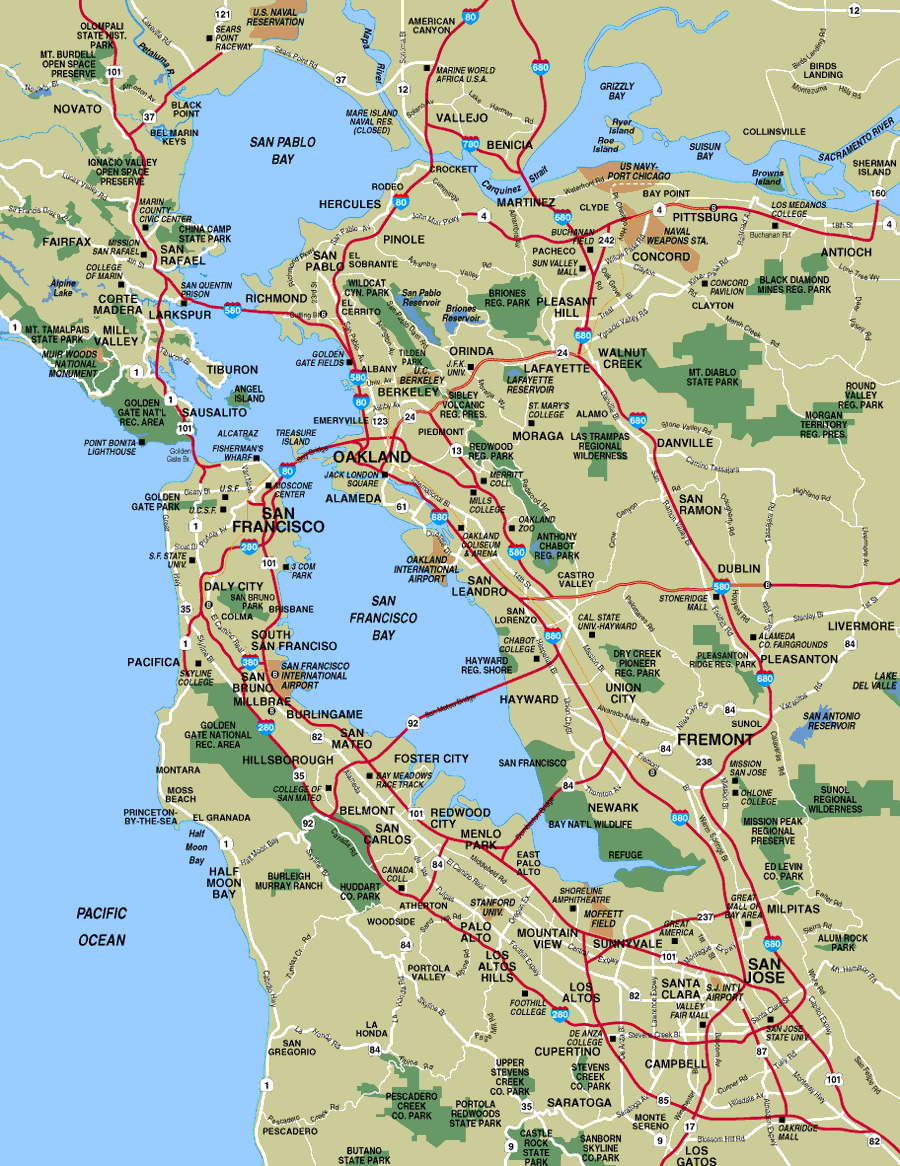
Historically, tech companies located themselves south of San Francisco in what came to be known as Silicon Valley (which is not actually a geographic valley; mostly the term refers to the San Francisco Peninsula south of San Francisco and the area around and including San Jose).  Now, some have satellite offices in San Francisco.  Newer tech companies, like their employees, tend to prefer being in San Francisco, largely for access to talent (but also because of tax breaks meant to attract these companies to the city -- Twitter is an (in)famous example).


Map of San Francisco Bay Area

***


Enter the "Googlebus."  For corporate employees living in San Francisco (and now Oakland as well), various companies, including Google, started to provide wifi-enabled double-decker corporate shuttles down to their main headquarters on the Peninsula.  For the companies, this solved three main problems: getting their employees to the corporate campuses in a reasonable amount of time, allowing the companies to employ people who lived in relatively distant cities and allowing the employees to work while commuting.

However, many in the Bay Area are not as happy about the corporate shuttle development, seeing it as an example of class stratification: "Googlebus" for the relatively well-off corporate employees, and subpar public transit for everyone else.  This sense is compounded by the fact that these behemoth busses cause inconvenience for other commuters by idling in (particularly) San Francisco streets waiting for the workers to file in, sometimes even at SF Muni bus stops.  (The city of SF is looking into fining the corporations for this practice.)


This pattern of economic and social bifurcation is familiar in American life in the past few decades, especially accelerating since the Great Recession.  Recall the slogans of Occupy: "We are the 99%!" and "Banks got bailed out; we got sold out!"  Many can only find work in temporary, low-paying and part-time jobs, if at all.  The austerity policies that are gutting social services, while a small elite's fortunes continue to rocket upwards, have not spared the Bay Area.  To just take one social services vertical, public education: San Francisco City College is in danger of losing its accreditation and tuition at state universities continue to rise in real terms.  Many see the "Googlebus" phenomenon as another instance of this 
bifurcation.

The other main issue besides transportation the protesters said motivated them was "gentrification." [2] By this, they mean the rise in housing rents which lead to displacement of long-time residents, and the resultant transformation of neighborhoods which often takes place along class and racial lines.  Since real estate prices have risen so dramatically in the Bay Area recently as a result of high demand and low supply, incentives for property owners to remove lower-paying tenants in favor of higher-paying ones has increased in tandem.  The notorious Ellis Act and other legal chicaneries are often used as the pretext to kick people out of their residences.  The direction of relatively poorer residents is moving, generally speaking, from San Francisco to Oakland and from Oakland out into the suburbs (and of course there are migration patterns within the cities, depending upon the perceived attractiveness of various neighborhoods).


***


There have been four (by my count) corporate shuttle blockades thus far.  Two in San Francisco (December 9th and December 20th) and two in Oakland (both on December 20th).  In each, a relatively small group of protesters surrounded a bus until the police came, and then everybody went on their way.  There is a different group of people protesting in each city.  The San Francisco group seems to be drawn from the NGO / professional activist crowd whereas the Oakland group appears to be frequenters of the Occupy Oakland / anarchist [3] protest scene.  The Oakland protesters were more aggressive, breaking a shuttle window on one occasion and handing out hostile flyers.


The anger shown towards tech employees by the Oakland protesters (and certainly, this sentiment pervades beyond their clique) is a bit perplexing.  After all, managers, lawyers and nurses, for instance, earn more in San Francisco than app developers.  Nurses are more numerous.  And there are no comparable protests against them.  In addition, the kinds of people who are aghast at the high salaries of tech workers were not too long ago defending the (sometimes) comparable salaries, perks and benefits of union members during the recent BART strikes. In any event, making a grievance out of the fact that another worker earns more or has better perks than another seems to be a race-to-the-bottom type strategy, typical of oppressive management, not leftist agitators.


Furthermore, the workers at, say, Google are not (if I may use Marxian terms) the bourgeoisie -- they're proletarians (albeit with better job conditions than was historically the case), and have many work-related grievances of their own.  Many work excruciatingly long hours, can be recalled to work at any time -- even the middle of the night (being "on call") and face discrimination at the workplace (there has been a cottage industry recently in journalism of highlighting sexism, racism, ageism, etc. in Silicon Valley).  Perhaps most ominously, capitalists, enraged by the high salaries that the engineer labor shortage mandates, are actively working to undercut salaries by means of, among other mechanisms, collusion, H1-B workers (who, because of their precarious legal status, are particularly vulnerable to management pressure), outsourcing, and expanding the domestic pool of labor (I suspect this is the motivating force behind the recent spike in interest in getting women to code -- not that gender egalitarianism shouldn't be a goal in its own right, of course).


I want to make clear that I support these protests, and think the tactic of blocking corporate shuttles is an entirely appropriate one to draw attention to inequalities in local life. [4] My gripe is that these issues are a lot bigger than Google employees, Google, or even "tech" (whatever that is).  They are issues that have their root in capitalism, fundamentally, and "tech" is just the way that these processes manifest themselves in the Bay Area.  Like-minded protesters in Detroit might, hypothetically, protest Big Auto, but they'd still be grasping a part of the same capitalist elephant.  Populist opportunism that looks for a convenient scapegoat like tech workers might seem like an attractive way to proceed, but it is ultimately a bad politics because it is intellectually incoherent.


Another question is: why are these protests happening now?  My theory is that we are currently at the point where the literary class -- that is, journalists, artists, activists, writers, editors, etc. -- are getting priced out of their current living situations.  Rebecca Solnit wrote her first "Googlebus"-bashing article (which I suppose could be considered the vanguard article of this genre), not coincidentally, with her recent experience of entering the San Francisco housing market in mind.  Many on this income level (lower than your average engineer, higher than your average janitor) despair that the cities they lived in for so long at relatively low prices (see the aforementioned fact that there is a new influx into cities, generally, and Bay Area cities in particular) no longer resemble the bohemian landscape they once knew -- especially when that landscape includes them.  They do, however, have access to the media, as well the ear of others willing and capable of street action.


***


What the larger public thinks about these dynamics is hard to discern (and is often drowned out by buffoonery, extremism and posturing on all sides... nothing new in Bay Area politics! [5]) but the University of San Francisco did conduct a recent study of San Franciscans' attitudes about tech and inequality.  Speaking in broad terms, citizens generally looked favorably on "tech's" contribution to the city and its economy (especially compared to the dismal national conditions -- my interpretation), but noted that inequality, especially in housing, was a concern.


In any event, valuable data about labor, urbanism, transportation and economics in the Bay Area that would shed light on this problem is very hard to come by.  Where do "tech" employees live?  What are their transportation patterns -- bikes, busses, trains?  How long have they been in the Bay Area, on average?  Are they migrating internally within the Bay Area?  If so, how?  What are their demographics?  What about other types of workers?  Etc.  Having the answers to these questions would complicate if not challenge the simplistic narrative of "White, male tech workers from outside who don't value our culture are coming into the Bay Area and displacing the long-time, minority, poor community members!" that seems to be so pervasive in some people's minds.  These answers may be available, but, so far as I have seen, they mostly haven't been surfacing in the local journalism.  This is partly the fault of journalism which (no surprise here) is poorly covering the issues (there are exceptions, of course).  It is also an issue of the declining resources going to journalism, so there is less research to go around.


What journalists have been covering are the more superficial aspects of gentrification and inequality -- the tropes of "tech workers behaving badly" and its righteous inverse ("Don't. Be. Fucking. Douchebags!").  But what the Bay Area is dealing with are primarily issues of class conflict, not issues of manners.  Even if every "tech bro" comported themselves with impeccable modesty and grace while riding the "Googlebus," they would still be riding the "Googlebus."


***


Part of what makes the Bay Area's political situation so hairy is that there is no one overriding issue eclipsing all others in importance.  "Gentrification"; income inequality; public transportation; urban planning; evictions; privatization of public space; non-payment of corporate taxes ... all are interrelated components of the predicament.  It's difficult to know where to start, or even how to talk about "the problem."


To add to the difficulty, there are significant numbers of people who aren't the Evil Capitalists of leftist lore who benefit from the aforementioned dynamics.  To give one example, rising real estate prices increase the value of homes, increasing the wealth of homeowners.  In this way, there is a direct economic antagonism between renters and homeowners.  Organizing a struggle against, say, real estate developers is one thing.  Organizing a struggle against real estate developers and owners of a third of San Francisco residential real estate and their families is another thing entirely.


One could propose plenty of solutions; here are some offhand.  Get a decent, integrated public transportation system.  Repeal the Ellis Act (and Prop 13, while we're at it).  Tax the rich... or just collect the taxes that they and corporations have been evading.  Expand housing supply in the cities, and make it denser.  Get stronger rent control laws.  Expand public housing.  Develop other areas in the Bay Area besides the cities.  Develop other areas nationally and internationally (although, of course, these would be outside of the Bay Area's control).  One word: regionalism -- eliminate the parochial interests that divide cities and counties and start planning with the whole Bay Area in mind.  Hey, we didn't even have to overthrow capitalism!  See how easy that was?


But, of course, implementing these measures is not as easy as snapping ones fingers.  And given the post-Occupy activist zeitgeist of not proposing any positive program, and existing reformist forces' inability to implement almost any political change, and the strength of capitalist forces moving us in precisely the opposite direction, I'm not optimistic that these issues will be resolved satisfactorily anytime soon.


The future of the bus-blockading tactic will probably be limited to its current manifestations: very motivated small groups of activists making symbolic, temporary stops of a limited number of corporate shuttles.  This is because the actions can't be publicly organized, and it is a pretty large request to ask a non-mobilized individual to start organizing in a bus-blockading clique -- it's not like a rally that one can stumble into where one has the anonymity and protection of being in a large crowd of likeminded people.  Generally, one can only use a tactic for so long before it fails to inspire people or the establishment figures out how to defeat it, but I don't think we're at that point quite yet.


There is a possibility that the groups already protesting could escalate the intensity of their tactics, moving more into vandalism and sabotage, or even commandeering the busses.  Such an intensification would raise the question of what the establishment response and popular response (or backlash) might be.  There is also the space for other symbolic actions against the corporate shuttles. [6]


In conclusion, partly as a result of its own historical screwups, and partially because of a national economic situation that is beyond its control, the Bay Area is in the midst of a difficult political situation regarding housing, transportation, labor, urban planning and income disparity.  Some resistance is emerging, but it is largely at the margins, even though its drama occasionally grabs headlines.  Solutions are easy to imagine but politically hard to implement, mostly because economic power is in the driver's seat.


***


[1] One never quite knows what is being referred to by "tech."  It could be large software corporations in the Bay Area; large software corporations in San Francisco; large corporations in San Francisco; large new corporations in San Francisco; biotechnology firms in the San Francisco Bay Area; the entrepreneurial startup scene; the network of venture capital funding; etc. etc. etc.  One of the difficulties in talking about it is that it can refer to so many things.  Walmart has sophisticated supply chain management technology -- is it "tech"?  What about Papa John's -- it has a website?  Or Microsoft and Amazon, even though they're not in the immediate Bay Area (but do have satellite offices here)?  Or distant firms that Bay Area residents telecommute to?

[2] When "gentrification" is invoked by a left-leaning individual, it is almost certainly in the pejorative.  There is a common method of argumentation against "gentrification," however, that is problematic.  Specifically, when a person of income (or privilege or whatever) X moves into a neighborhood and then immediately declares that she is against "gentrification," particularly for people of incomes higher than X.  The hypocrisy therein -- that she was part of the "gentrification" process not long ago -- seems to escape only the people making these kinds of arguments.  The point is nobody has an overriding moral claim to land in the Bay Area; everyone was part of the chain of "gentrification" at one point or another (notwithstanding Native Americans).  


Other arguments against "gentrification" focus on cultural forces that are being created or destroyed or are changing, but these are very subjective, fetishize a mythical and timeless notion of a location's essence, and are, in my mind, unconvincing.  Moreover, it is undeniable that "gentrification" brings some positive benefits -- the issue is just that those benefits are distributed unequally.  None of this is to suggest, however, that people should be extracted against their will from their homes either by legal or economic circumstances, which is what I understand to be the main problem with "gentrification."


To sum up, arguments against "gentrification" often misstate the problems with it.  We should probably use a new term that ditches the argumentative baggage associated with "gentrification" to describe the perceived negative changes that occur in a location when real estate prices rise.


[3] Anytime one talks about protests in the East Bay identified by most media as "anarchist," one also needs to recognize that "anarchist" is an imprecise label that doesn't describe the political philosophy of all the participants of the protest. 


[4] Just to elaborate on why I support the protests: to be a successful action, an action must satisfy two requirements -- it must be well-targeted, and it must be educational.  I think the bus blockades satisfy both conditions, as the "Googlebus" is a symbol of class inequality whose blockage only hurts the pockets of the large corporations, if at all.  And the flyers, while I, as I state, disagree with some of the content, were generally on point regarding class stratification in the Bay Area.  One doesn't have to endorse every last word of every flyer that is handed out at an action to endorse it (an impossible standard that would result in not being able to support any protest).  Also, one can't fault these actions for lack of effectiveness, given the limited resources of the protesters.  As is often the case, these protests are largely symbolic -- asking them to singlehandedly bring down Google, for instance, would be entirely unreasonable.


[5] I think my favorite loopy ideology came from a protester who advocated something similar to Mitt Romney's self-deportation strategy for undocumented immigrants at this earlier protest, notable for its smashing of a "Googlebus" piƱata.  Her words were, approximately, "GentriFUCKation!  There's not enough space for both the real residents of San Francisco and the outsiders!  If you're from Wisconsin, or Ohio, or Indiana, maybe you need to leave and go home to where you came from!"  But, rest assured, there are plenty of other contenders for the loopiest ideology crown.


[6] Symbolic action could potentially include:

- The announcement of a "free ride on the Googlebus day" where anyone is encouraged to board the corporate shuttles and to go to the corporate campuses, or perhaps to demand they operate as Muni busses since they are Muni stops; entertaining street theater ensues
- Renting a corporate shuttle and masquerading as a "Googlebus," bringing the corporate employees to an entirely different location, or perhaps brining them to the corporate campuses, while playing an informative video about corporate malfeasance / the economic situation the entire way
- Distributing pamphlets, etc. to corporate employees while they are stationary, queued for their shuttle (employees are likely under instructions from corporate PR to not interact with any protesters)
- Turning the "Googlebus" into a giant banner rolling down the highway by spray-painting some slogan on the side
- etc.